Monday, May 2, 2011
UC Santa Barbara to get $7.5 million for quantum computing
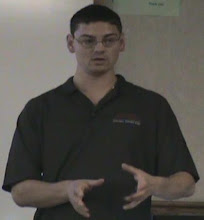
UC Santa Barbara is getting $7.5 million for quantum computing research from the Defense Department. The work will be lead by Awschalom.


Thursday, March 24, 2011
Quantum Public Key Encryption

One of the most cited benefits of a quantum computer is that it can factor, therefore breaking many current public key encryption systems. That makes this recent paper by Kawachi, Koshiba, Nishimura, and Yamakami certainly interesting: a quantum version of public key encryption. Here's a brief article in MIT Technology Review, and the paper on arXiv. The abstract:
We introduce a computational problem of distinguishing between two specific quantum states as a new cryptographic problem to design a quantum cryptographic scheme that is "secure" against any polynomial-time quantum adversary. Our problem, QSCDff, is to distinguish between two types of random coset states with a hidden permutation over the symmetric group of finite degree. This naturally generalizes the commonly-used distinction problem between two probability distributions in computational cryptography. As our major contribution, we show that QSCDff has three properties of cryptographic interest: (i) QSCDff has a trapdoor; (ii) the average-case hardness of QSCDff coincides with its worst-case hardness; and (iii) QSCDff is computationally at least as hard as the graph automorphism problem in the worst case. These cryptographic properties enable us to construct a quantum public-key cryptosystem, which is likely to withstand any chosen plaintext attack of a polynomial-time quantum adversary. We further discuss a generalization of QSCDff, called QSCDcyc, and introduce a multi-bit encryption scheme that relies on similar cryptographic properties of QSCDcyc.
(Image from the paper.)
Quantum Information in the Mainstream
It looks as if quantum information is starting to enter the mainstream: US News and World Report has an article on using diamonds for quantum memory.
Saturday, March 12, 2011
Classical Simulation of Quantum Adiabatic Algorithms using Mathematica on GPUs

Simulation of quantum computers is what allows us to test quantum software on a limited scale. Therefore this recent paper by Díaz-Pier, Venegas-Andraca, and Gómez-Muñoz, Classical Simulation of Quantum Adiabatic Algorithms using Mathematica on GPUs is of interest. The abstract:
In this paper we present a simulation environment enhanced with parallel processing which can be used on personal computers, based on a high-level user interface developed on Mathematica\copyright which is connected to C++ code in order to make our platform capable of communicating with a Graphics Processing Unit. We introduce the reader to the behavior of our proposal by simulating a quantum adiabatic algorithm designed for solving hard instances of the 3-SAT problem. We show that our simulator is capable of significantly increasing the number of qubits that can be simulated using classical hardware. Finally, we present a review of currently available classical simulators of quantum systems together with some justifications, based on our willingness to further understand processing properties of Nature, for devoting resources to building more powerful simulators.(Image is figure 1 from the paper.)
Sunday, February 27, 2011
Solid state qubits
More progress on physical implementations of quantum computers: solid state qubits?
Wednesday, February 16, 2011
arXiv: Advances in Quantum Metrology

From arXiv: Advances in Quantum Metrology by Giovannetti, Lloyd, Maccone. It is a preliminary version, but still an intriguing topic. The abstract:
In classical estimation theory, the central limit theorem implies that the statistical error in a measurement outcome can be reduced by an amount proportional to n^(-1/2) by repeating the measures n times and then averaging. Using quantum effects, such as entanglement, it is often possible to do better, decreasing the error by an amount proportional to 1/n. Quantum metrology is the study of those quantum techniques that allow one to gain advantages over purely classical approaches. In this review, we analyze some of the most promising recent developments in this research field. Specifically, we deal with the developments of the theory and point out some of the new experiments. Then we look at one of the main new trends of the field, the analysis of how the theory must take into account the presence of noise and experimental imperfections.
(The image is figure 2 from the paper.)
Subscribe to:
Posts (Atom)